Wednesday, October 25, 2006
My bad.
I've been slacking hella bad on this blog lately. Sorry, lot's of things going on in my life right now. I'll pick it up, fresh start...Books sales doing okay. Comments good!

Wednesday, August 16, 2006
A Letter From Bambaataa...
Aside from the fact that there are typos in this letter, albeit some on purpose, this letter makes an important point about the power of the media. Indeed, I too am worried about the 'global human aura' right now.
****
PEACE AND BLESSING TO All of Our Family of Warriors, Thinkers and Leaders:
Hope your are in the best of Health and your families. I was sent your e-mail by the Zulu-staff . I have been living in Europe for the past couple of months and been waking as many up to what we're, doing in the states cause in some places they have the same problems with radio,especially the ones that copy The United States formats or programming of music. Then there are those specials stations that do have a balance of Ma'at on the airwaves and you hear it all.
One thing that did bother me is that these so called Rap /Hip Hop
radio stations here in some parts of Germany, France, Estonia, Croatia, Spain and even good old Great Britain underground play alot of the rap records with cursing. Their excuse is the people do not know the language anyway and my answer to them is, that is bull and you DJ's know there are many that do know some type of English and many of your are playing the curse version cause your think that makes your hardcore and down with the tuff side of what your think the United States Hip Hop/Rap is all about. That your all are helping with the conspiracy to mess up minds all over the world. After I got finish with some of these so called Hip Hop/ Music show host ,you know they could not wait to get me out of their radio stations. Especially some of the jive ones who think they know it all about Hip Hop/Funk/Soul/Rock/Latin/Soca/Jazz/House/Techno in England and other places to many to name.
You can feel the phony in all of them and their are a very few I can say who really do not know what their doing but there are the rest of them that exactly know what they are doing to the airwaves. Guess what! their are many and I mean many over here in Europe who are also tired of their radio stations that play the same music over and over again,as well as their media of television. Also Family The NWO is getting in full swing here and Mr. Tony Blair of the United Kingdom (England) is talking strong now about their Smart cards that are coming and if he is speaking strong now about it, you know their children of the UK= USA will be following to.
Family there is so much work to be done that it is disgrace-full to see with all this chaos all over the world going on,all the problems in MaMa Afrika, In India, The States and South America with crazy things happening in Europe to and those of us that do have the serious knowledge, we know what is really going on and have to prepare now if we are to survive the onslaught that is coming. All the things I have been talking for years is on the move right before us and if you hear what brother Phil Valentine, Bobby Hemit,and many of the Meta physical community of higher learning have been dropping, it is about to get super serious. The people's mind set all over this Great Planet is jacked up and the programming of these radio and T.V shows is playing a super big role to destroy Human mentality to think and to reason. If we can not get a movement of Humans to try and change the programming of these radio and T.V. stations which is just one step of many ,then we have some serious reactions of hell that will be all over this Earth.
I would like for your if you can and whomever else to put a list of solutions that we can put together with others on a cross the board scale that all states even other countries can follow in letting people know what can they do to help change the situations of programming of Radio and Television. We want to put as many things out with flyers to give out to all that will come out in November for The Meeting of The Mind ,The Balance Of Ma'at. We are going for two days to address this situation and with these papers of solutions we are calling on everyone to be accountable to what is going on in their respected Cities, Towns, States, Countries to move into action cause if they do nothing ,Then They Deserve What They Get. Also we need to reach out to many Leaders, Thinkers, Activist, Religious Heads, Movers, Actionist to represent and come out with solutions to this event for Hip Hop History Month and to all that are doing something to make change, we must push, salute and help back to the fullest our support. Stop the Killing of the Mind.
I will be back soon. If Allah willing, but you can start speaking to Brother Yoda, Dr. Shaka (zulustaff@earthlink.net) and to whomever else for we can make a movement more successful. We all have been speaking, fighting, teaching,s truggling, winning some for a moment, losing some but keep on pushing to keep what we know is right to do.
As I said many times before The Lucerferians are on the move and the Armies of Almighty RA/Allah/Jah/Yaweh/Elohim/Anu/Theos/Shango/Zeus/Oden and whatever else people want to call the Supreme Force must Rise or The Empire will Strike Back to bring Hell all over This planet so called Earth.
May The Supreme Force Bless Us All and keep Us All Always Protected against All our Enemies.
Peace ,Unity, Love, Freedom or Death, Justice
The Spirit Of Professor X Lives On
Afrika Bambaataa
The Amen Ra of Universal Hip Hop Culture
Each One Teach One,Feed One,Help One,Live as One,Leave all Egos in the Garbage
Save Planet Earth
****
Straight up-screw the pompous who profit with no respect for the predecessors or posterity. It's hard not to get sucked in by mass-media though, that's for sure. Doesn't make it okay, and certainly does not make turning blind eyes to injustice or being apathetic about your own individual ability to make a difference acceptable. Have your fun! BUT sincerely move to positively affect your surroundings as well.
****
PEACE AND BLESSING TO All of Our Family of Warriors, Thinkers and Leaders:
Hope your are in the best of Health and your families. I was sent your e-mail by the Zulu-staff . I have been living in Europe for the past couple of months and been waking as many up to what we're, doing in the states cause in some places they have the same problems with radio,especially the ones that copy The United States formats or programming of music. Then there are those specials stations that do have a balance of Ma'at on the airwaves and you hear it all.
One thing that did bother me is that these so called Rap /Hip Hop
radio stations here in some parts of Germany, France, Estonia, Croatia, Spain and even good old Great Britain underground play alot of the rap records with cursing. Their excuse is the people do not know the language anyway and my answer to them is, that is bull and you DJ's know there are many that do know some type of English and many of your are playing the curse version cause your think that makes your hardcore and down with the tuff side of what your think the United States Hip Hop/Rap is all about. That your all are helping with the conspiracy to mess up minds all over the world. After I got finish with some of these so called Hip Hop/ Music show host ,you know they could not wait to get me out of their radio stations. Especially some of the jive ones who think they know it all about Hip Hop/Funk/Soul/Rock/Latin/Soca/Jazz/House/Techno in England and other places to many to name.
You can feel the phony in all of them and their are a very few I can say who really do not know what their doing but there are the rest of them that exactly know what they are doing to the airwaves. Guess what! their are many and I mean many over here in Europe who are also tired of their radio stations that play the same music over and over again,as well as their media of television. Also Family The NWO is getting in full swing here and Mr. Tony Blair of the United Kingdom (England) is talking strong now about their Smart cards that are coming and if he is speaking strong now about it, you know their children of the UK= USA will be following to.
Family there is so much work to be done that it is disgrace-full to see with all this chaos all over the world going on,all the problems in MaMa Afrika, In India, The States and South America with crazy things happening in Europe to and those of us that do have the serious knowledge, we know what is really going on and have to prepare now if we are to survive the onslaught that is coming. All the things I have been talking for years is on the move right before us and if you hear what brother Phil Valentine, Bobby Hemit,and many of the Meta physical community of higher learning have been dropping, it is about to get super serious. The people's mind set all over this Great Planet is jacked up and the programming of these radio and T.V shows is playing a super big role to destroy Human mentality to think and to reason. If we can not get a movement of Humans to try and change the programming of these radio and T.V. stations which is just one step of many ,then we have some serious reactions of hell that will be all over this Earth.
I would like for your if you can and whomever else to put a list of solutions that we can put together with others on a cross the board scale that all states even other countries can follow in letting people know what can they do to help change the situations of programming of Radio and Television. We want to put as many things out with flyers to give out to all that will come out in November for The Meeting of The Mind ,The Balance Of Ma'at. We are going for two days to address this situation and with these papers of solutions we are calling on everyone to be accountable to what is going on in their respected Cities, Towns, States, Countries to move into action cause if they do nothing ,Then They Deserve What They Get. Also we need to reach out to many Leaders, Thinkers, Activist, Religious Heads, Movers, Actionist to represent and come out with solutions to this event for Hip Hop History Month and to all that are doing something to make change, we must push, salute and help back to the fullest our support. Stop the Killing of the Mind.
I will be back soon. If Allah willing, but you can start speaking to Brother Yoda, Dr. Shaka (zulustaff@earthlink.net) and to whomever else for we can make a movement more successful. We all have been speaking, fighting, teaching,s truggling, winning some for a moment, losing some but keep on pushing to keep what we know is right to do.
As I said many times before The Lucerferians are on the move and the Armies of Almighty RA/Allah/Jah/Yaweh/Elohim/Anu/Theos/Shango/Zeus/Oden and whatever else people want to call the Supreme Force must Rise or The Empire will Strike Back to bring Hell all over This planet so called Earth.
May The Supreme Force Bless Us All and keep Us All Always Protected against All our Enemies.
Peace ,Unity, Love, Freedom or Death, Justice
The Spirit Of Professor X Lives On
Afrika Bambaataa
The Amen Ra of Universal Hip Hop Culture
Each One Teach One,Feed One,Help One,Live as One,Leave all Egos in the Garbage
Save Planet Earth
****
Straight up-screw the pompous who profit with no respect for the predecessors or posterity. It's hard not to get sucked in by mass-media though, that's for sure. Doesn't make it okay, and certainly does not make turning blind eyes to injustice or being apathetic about your own individual ability to make a difference acceptable. Have your fun! BUT sincerely move to positively affect your surroundings as well.
Monday, August 14, 2006
Abducted In Iraq, Pt. 1 of Jill Carroll's Story
This is a first-person account by a journailist who was kidnapped and survived her ordeal.
******
KIDNAP
Jill Carroll, Christian Science Monitor
Monday, August 14, 2006
My chief captor had an idea about how to prod the U.S. government into action: another video. He said this one would be different, and left.
I turned to the two guards sitting on cushions a few feet away and started to panic. Really, really panic.
"Oh my God, oh my God, they're going to kill me, this is going to be it. I don't know when but they're going to do it," I thought.
I crawled over to Abu Hassan, the one who seemed more grown-up and sympathetic. His 9mm pistol was by his side, as usual.
"You're my brother, you're truly my brother," I said in Arabic. "Promise me you will use this gun to kill me by your own hand. I don't want that knife, I don't want the knife, use the gun."
I started to cry hysterically. By now I'd been held captive by Iraqi insurgents for six weeks. They'd given me a new hijab, a new name (Aisha), and tried to convert me to Islam. They'd let me play with their children -- and repeatedly accused me of working for the CIA.
At night I'd fall asleep and be free in my dreams. Then I'd wake up and my situation would land on me like a weight. Every morning, it was as if I was kidnapped anew.
That particular morning I'd received a visit from Abu Nour, the most senior of my captors. As usual, the distinctive scent of his spicy cologne had announced his presence. As usual, I'd snapped my eyes to the ground to avoid seeing his face.
"We need to make a new video of you," he'd said in his high-pitched, yet gravelly voice. "The last video showed you in good condition, and that made the government move slowly."
The British government had moved quickly, he'd said, after a video had shown hostage Margaret Hassan in bad condition. They wanted to push the United States in the same way.
Margaret Hassan! An Irish aid worker married to an Iraqi, she'd been seized in Baghdad in October 2004, while on her way to work. Less than a month later, she was killed.
After the leader left, I sat and stared into the glowing metal of the propane heater, my knees drawn up under my red velveteen dishdasha. I was completely terrified.
If it was going to happen, I wanted it to be quick. So I crawled over to Hassan and begged.
"I don't want the knife!" I sobbed.
Neither Hassan nor his fellow guard -- the blubbery, adolescent Abu Qarrar -- really knew what to do about my outburst.
"We're not going to kill you. Why? What is this?" said Hassan.
His voice was flat and sounded insincere.
"Abu Qarrar, you speak English. You have to tell my family that I love them and that I'm sorry," I implored.
I sat against the wall of a house whose location I didn't know, under a window to an outside I couldn't walk through, and cried and cried.
In Baghdad, Jan. 7, 2006 was a sunny Saturday. For me it promised to be an easy day.
First up were some routine interviews of Iraqi politicians trying to form a new government. Three weeks before, the country had chosen its first democratically elected permanent government. But Sunni politicians were dismayed at how few seats they'd won.
Later, I planned to leave my virus-ridden laptop (stashed in the trunk) with a techie friend of my interpreter, Alan Enwiya.
Alan was vital to my newsgathering process. We had been a team for almost two years. We were also friends -- it felt as if we were almost siblings -- who'd worked through Iraq's difficult and increasingly dangerous conditions.
We had been threatened by militia members, mobbed after Friday prayers, and seen bullets rain down from passing police vehicles. We'd walked hours through Baghdad soliciting interviews from ordinary Iraqi voters.
During long days in traffic jams, Alan would tell me funny stories about his daughter and infant son, marveling at how fast they were growing. I would tease him that I was a spy for his wife, Fairuz, and would report to her if I caught him looking in the direction of a pretty girl.
The first interview on our list that morning was Adnan al-Dulaimi, a Sunni politician. While there was a handful of what Western journalists considered no-go neighborhoods in Baghdad, his office wasn't in that category yet. But we had taken our normal security precautions. I was dressed, for example, in a black hijab that hid my hair and Western clothes. We'd been to Dulaimi's office several times before without a problem. Our last trip had been two days earlier to set up this interview.
In retrospect, that was a fatal mistake; we had given someone 48 hours to prepare for our return.
Adnan Abbas, the Monitor's longtime driver -- who'd shared many of our harrowing experiences -- guided his maroon Toyota sedan along the familiar route to Dulaimi's office, dropping us off 20 minutes earlier than the scheduled time of 10 a.m.
Inside, Dulaimi's aides steered us away from the usual waiting room full of men drinking sweet tea in tiny glasses, and into an adjoining room where we were alone. Alan and I noticed the strangeness of this move at the same moment.
"Well, it's better," Alan said. "You're a woman and there are a lot of men in there."
The minutes passed and aides walked through the room chatting on cell phones. I understood through my rudimentary Arabic that they were telling various people that a reporter was waiting to see Dulaimi. But a little after 10 a.m. the same aide who had made the appointment for us approached us.
"Sorry, Dr. Dulaimi has a press conference right now," the aide said. "He can't talk to you. Can you come back at 12?"
I wondered why I hadn't heard about the press conference before now.
We agreed to come back later and stepped out into the bright sunny morning where Adnan was waiting for us.
As we walked to the car, Alan reminded me that we needed to call ahead to make sure our next interview was still on. He climbed into the front, and I handed him my phone from the back seat, my usual place. He began shouting into the phone, trying to make himself heard over Baghdad's overloaded, spotty cell phone network.
Adnan had begun to pull away, but suddenly a large blue truck with red and yellow trim backed out of a driveway in front of us, completely blocking the road. Several men were standing around it, motioning to help it back out.
But in an instant they turned, trained pistols on us and briskly approached the car.
Adnan hit the brakes, and he and Alan put their hands up. It was a routine we had become familiar with in Baghdad, where private security details often brandish weapons to clear a path for their clients.
But unlike the previous times, the men didn't lower their weapons -- and they kept advancing. The man closest to the car, a rotund person with salt-and-pepper stubble, had his gun aimed right through the windshield at Adnan.
My eyes were glued to him. I was confused about why he didn't lower his pistol. At the same time Adnan and Alan opened their doors and began to get out of the car.
The gunmen ran at us. A whisper exploded from me into a scream, "No, no, NO!" as I tried to get out. The door closed on my right ankle as someone shoved me back in, pushing so hard that the right lens of my glasses popped out. Through the crack in the door -- before the intruder slammed it -- I saw the last moment of Alan's life.
Adnan was gone. The rotund man was in the driver's seat now. Other men jumped in sandwiching me between them. We sped away, out onto the main road, then turned right.
"Jihad! Jihad! Jihad!" my abductors shouted, excited and joyful. "Jihad! Jihad!"
In the first minutes after my abduction, my captors peppered me with questions in Arabic. I played dumb, fearful they would think I understood too much and kill me.
They quickly drove Adnan's Toyota onto the highways of western Baghdad and surrounding farmlands, going in circles, apparently to kill time. Their "success" was granted by God, they believed, and they issued thanks repeatedly. "Allahu Akbar" they said, "God is greatest."
"They're going to take me out into a field and kill me," I thought as we bumped down rural back roads.
They seemed to read my thoughts, perplexed that I was afraid amidst their jubilation.
"Why you worried?" they asked in stilted English. "No, no, no, (this is) jihad! (We are) Iraqi, Iraqi mujahedeen! Why you worried?"
Sunni Muslim insurgents were -- still are -- the most active hostage-takers in Iraq. Many were allied to Abu Musab al-Zarqawi, the Jordanian who led al Qaeda in Iraq until he was killed by a U.S. air strike June 7.
But the outside world didn't know much about these groups. These weren't people who held press conferences or articulated their grievances through the political process.
They were a powerful force in Iraq, but they were like shadows behind a curtain. We could see broad outlines, but were left to guess at who they really were, how they think, and what motivates them.
Alan and I had been focusing for several months on piecing together a clear picture of Iraq's Sunni community. Their tacit support for the insurgency allowed it to operate; understanding them was key to understanding the forces violently splitting the country.
Now I was to gain the insight we had so long sought. At such a price to Alan, I have never been so desperate for ignorance.
The room was small, with furniture that was fancy by Iraqi standards -- two couches and an overstuffed chair covered in dark velvet with gold trim. The TV and its satellite box were in the corner.
Abu Rasha -- a big man whom I would come to see as an organizer of my guards -- lay down on one of the sofas. His wife and one of his children sat next to him on a chair.
Then Rasha handed me the remote. "Whatever you want," he said.
How do you channel surf with the mujahedeen? I asked myself that question as I flipped from one show to another, trying to act casual. Politics was out. News was out. Anything that might show even a flash of skin was out.
Finally, I found Channel 1 from Dubai, and Oprah was on. A-OK, good, Oprah, I thought. No naked women, no whatever, she's not in hijab, but it's OK.
The show was about people who had had really bad things happen to them, and had survived, and had hope. One woman came on who had been a model in the '70s and had breast cancer, and now she's a famous photographer. Oprah talked about how people get through these things, and I thought, well, this is sort of prophetic, maybe.
I had only been in captivity a few hours. This house, big, with two stories, was the second place I'd been taken.
The first had been a tiny, three-room house among tall crops on Baghdad's western outskirts. It was a poor place, built of cinder blocks. My captors gave me a new set of clothes, and I changed in the bathroom while the stern-faced woman of the house looked on.
They took pains to explain they wouldn't take the $100 in cash they'd found in my pockets.
"When you return to America, this with you," said one, waving the $100 bill.
Who were these people? Kidnapping was justified but taking money was not? And less than an hour after killing Alan to kidnap me, they seemed to be saying they would eventually let me go.
Then we drove to the second house, which appeared to be the home of one of the kidnappers, who'd given his name as Rasha.
They took me upstairs to the master bedroom. Within a few minutes an interpreter arrived, and an interrogation began.
They wanted to know my name, the name of my newspaper, my religion, how much my computer was worth, did it have a device to signal the government or military, if I or anyone in my family drank alcohol, how many American reporters were in Baghdad, did I know reporters from other countries, and myriad other questions.
Then, the interpreter explained the situation.
"You are our sister. We have no problem with you. Our problem is with your government. We just need to keep you for some time. We want women freed from Abu Ghraib prison. Maybe four or five women. We want to ask your government for this," the interpreter said. (At the time, it was reported that 10 Iraqi women were among 14,000 Iraqis being held by coalition forces on suspicion of insurgent activity.)
"You are to stay in this room. And this window, don't put one hand on this window," he continued. "I have a place underground. It is very dark and small, and cold, and if you put one hand on this window, we will put you there. Some of my friends said we should put you there, but I said, 'No she is a woman.' Women are very important in Islam."
After that they fed me from a platter of chicken and rice that would have been fit for an honored guest. And I was invited downstairs to watch television with Rasha's family.
That's when we'd watched Oprah. Afterward, Rasha asked me what I liked to eat for breakfast, and what time I had it. It was part of this pattern -- they all seemed concerned that I think they were good, or at least that they were treating me well.
But in my mind every second was a test -- the choice of food, TV program, everything -- and they would kill me if I gave the wrong answer.
Eventually I told them I wanted to sleep, and they led me upstairs. I lay in bed, on the far side away from the window. The clock was ticking loudly, and then it started to rain. I love rain, and I thought, oh, maybe this is a good sign.
But I'd been performing all day, holding in my emotions, and with darkness they came flooding back.
"Oh my God. They killed Alan." A tide of emotion was racing toward me. It was going to drown me or send me flinging myself against the walls in anger and screams. I had to stop it.
"I cannot grieve now. I cannot do this now. I have to put it away," I thought.
I looked up into the darkness of the ceiling toward Alan. "I'm sorry," I told him. "I'll take care of you later." I felt disloyal. I thought to survive, I had to push aside the memory of his brutal murder. But I knew that at some point I'd have to come to terms with the guilt I felt for his death.
As night fell, I wondered if my friends had heard. I knew that by this point Alan's family, his wife, Fairuz, was realizing the worst.
"Well, now they must know," I thought. "It's dark. He hasn't come home. They must be screaming. Fairuz must be screaming."
How to help
Alan Enwiya is one of nearly 100 journalists and media assistants killed in Iraq since March 2003. Alan is survived by his wife, Fairuz, his two children, Martin and Mary Ann, and his parents.
The Christian Science Monitor has set up a fund to help support Alan's family and to enable them to start a new life in the United States, where they have relatives.
Donations may be sent to:
The Alan Enwiya Fund
c/o Christian Science Monitor
1 Norway Street
Boston, MA 02115
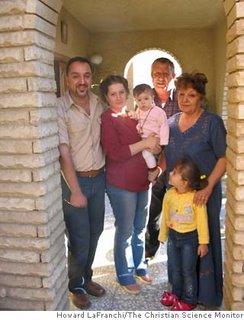
Alan Enwiya, in shirtsleeves, was the Iraqi interpreter for the Christian Science Monitor who was killed during the abduction of Jill Carroll. He is shown with his family in an undated photograph. Christian Science Monitor photo by Howard LaFranchi
******
KIDNAP
Jill Carroll, Christian Science Monitor
Monday, August 14, 2006
My chief captor had an idea about how to prod the U.S. government into action: another video. He said this one would be different, and left.
I turned to the two guards sitting on cushions a few feet away and started to panic. Really, really panic.
"Oh my God, oh my God, they're going to kill me, this is going to be it. I don't know when but they're going to do it," I thought.
I crawled over to Abu Hassan, the one who seemed more grown-up and sympathetic. His 9mm pistol was by his side, as usual.
"You're my brother, you're truly my brother," I said in Arabic. "Promise me you will use this gun to kill me by your own hand. I don't want that knife, I don't want the knife, use the gun."
I started to cry hysterically. By now I'd been held captive by Iraqi insurgents for six weeks. They'd given me a new hijab, a new name (Aisha), and tried to convert me to Islam. They'd let me play with their children -- and repeatedly accused me of working for the CIA.
At night I'd fall asleep and be free in my dreams. Then I'd wake up and my situation would land on me like a weight. Every morning, it was as if I was kidnapped anew.
That particular morning I'd received a visit from Abu Nour, the most senior of my captors. As usual, the distinctive scent of his spicy cologne had announced his presence. As usual, I'd snapped my eyes to the ground to avoid seeing his face.
"We need to make a new video of you," he'd said in his high-pitched, yet gravelly voice. "The last video showed you in good condition, and that made the government move slowly."
The British government had moved quickly, he'd said, after a video had shown hostage Margaret Hassan in bad condition. They wanted to push the United States in the same way.
Margaret Hassan! An Irish aid worker married to an Iraqi, she'd been seized in Baghdad in October 2004, while on her way to work. Less than a month later, she was killed.
After the leader left, I sat and stared into the glowing metal of the propane heater, my knees drawn up under my red velveteen dishdasha. I was completely terrified.
If it was going to happen, I wanted it to be quick. So I crawled over to Hassan and begged.
"I don't want the knife!" I sobbed.
Neither Hassan nor his fellow guard -- the blubbery, adolescent Abu Qarrar -- really knew what to do about my outburst.
"We're not going to kill you. Why? What is this?" said Hassan.
His voice was flat and sounded insincere.
"Abu Qarrar, you speak English. You have to tell my family that I love them and that I'm sorry," I implored.
I sat against the wall of a house whose location I didn't know, under a window to an outside I couldn't walk through, and cried and cried.
In Baghdad, Jan. 7, 2006 was a sunny Saturday. For me it promised to be an easy day.
First up were some routine interviews of Iraqi politicians trying to form a new government. Three weeks before, the country had chosen its first democratically elected permanent government. But Sunni politicians were dismayed at how few seats they'd won.
Later, I planned to leave my virus-ridden laptop (stashed in the trunk) with a techie friend of my interpreter, Alan Enwiya.
Alan was vital to my newsgathering process. We had been a team for almost two years. We were also friends -- it felt as if we were almost siblings -- who'd worked through Iraq's difficult and increasingly dangerous conditions.
We had been threatened by militia members, mobbed after Friday prayers, and seen bullets rain down from passing police vehicles. We'd walked hours through Baghdad soliciting interviews from ordinary Iraqi voters.
During long days in traffic jams, Alan would tell me funny stories about his daughter and infant son, marveling at how fast they were growing. I would tease him that I was a spy for his wife, Fairuz, and would report to her if I caught him looking in the direction of a pretty girl.
The first interview on our list that morning was Adnan al-Dulaimi, a Sunni politician. While there was a handful of what Western journalists considered no-go neighborhoods in Baghdad, his office wasn't in that category yet. But we had taken our normal security precautions. I was dressed, for example, in a black hijab that hid my hair and Western clothes. We'd been to Dulaimi's office several times before without a problem. Our last trip had been two days earlier to set up this interview.
In retrospect, that was a fatal mistake; we had given someone 48 hours to prepare for our return.
Adnan Abbas, the Monitor's longtime driver -- who'd shared many of our harrowing experiences -- guided his maroon Toyota sedan along the familiar route to Dulaimi's office, dropping us off 20 minutes earlier than the scheduled time of 10 a.m.
Inside, Dulaimi's aides steered us away from the usual waiting room full of men drinking sweet tea in tiny glasses, and into an adjoining room where we were alone. Alan and I noticed the strangeness of this move at the same moment.
"Well, it's better," Alan said. "You're a woman and there are a lot of men in there."
The minutes passed and aides walked through the room chatting on cell phones. I understood through my rudimentary Arabic that they were telling various people that a reporter was waiting to see Dulaimi. But a little after 10 a.m. the same aide who had made the appointment for us approached us.
"Sorry, Dr. Dulaimi has a press conference right now," the aide said. "He can't talk to you. Can you come back at 12?"
I wondered why I hadn't heard about the press conference before now.
We agreed to come back later and stepped out into the bright sunny morning where Adnan was waiting for us.
As we walked to the car, Alan reminded me that we needed to call ahead to make sure our next interview was still on. He climbed into the front, and I handed him my phone from the back seat, my usual place. He began shouting into the phone, trying to make himself heard over Baghdad's overloaded, spotty cell phone network.
Adnan had begun to pull away, but suddenly a large blue truck with red and yellow trim backed out of a driveway in front of us, completely blocking the road. Several men were standing around it, motioning to help it back out.
But in an instant they turned, trained pistols on us and briskly approached the car.
Adnan hit the brakes, and he and Alan put their hands up. It was a routine we had become familiar with in Baghdad, where private security details often brandish weapons to clear a path for their clients.
But unlike the previous times, the men didn't lower their weapons -- and they kept advancing. The man closest to the car, a rotund person with salt-and-pepper stubble, had his gun aimed right through the windshield at Adnan.
My eyes were glued to him. I was confused about why he didn't lower his pistol. At the same time Adnan and Alan opened their doors and began to get out of the car.
The gunmen ran at us. A whisper exploded from me into a scream, "No, no, NO!" as I tried to get out. The door closed on my right ankle as someone shoved me back in, pushing so hard that the right lens of my glasses popped out. Through the crack in the door -- before the intruder slammed it -- I saw the last moment of Alan's life.
Adnan was gone. The rotund man was in the driver's seat now. Other men jumped in sandwiching me between them. We sped away, out onto the main road, then turned right.
"Jihad! Jihad! Jihad!" my abductors shouted, excited and joyful. "Jihad! Jihad!"
In the first minutes after my abduction, my captors peppered me with questions in Arabic. I played dumb, fearful they would think I understood too much and kill me.
They quickly drove Adnan's Toyota onto the highways of western Baghdad and surrounding farmlands, going in circles, apparently to kill time. Their "success" was granted by God, they believed, and they issued thanks repeatedly. "Allahu Akbar" they said, "God is greatest."
"They're going to take me out into a field and kill me," I thought as we bumped down rural back roads.
They seemed to read my thoughts, perplexed that I was afraid amidst their jubilation.
"Why you worried?" they asked in stilted English. "No, no, no, (this is) jihad! (We are) Iraqi, Iraqi mujahedeen! Why you worried?"
Sunni Muslim insurgents were -- still are -- the most active hostage-takers in Iraq. Many were allied to Abu Musab al-Zarqawi, the Jordanian who led al Qaeda in Iraq until he was killed by a U.S. air strike June 7.
But the outside world didn't know much about these groups. These weren't people who held press conferences or articulated their grievances through the political process.
They were a powerful force in Iraq, but they were like shadows behind a curtain. We could see broad outlines, but were left to guess at who they really were, how they think, and what motivates them.
Alan and I had been focusing for several months on piecing together a clear picture of Iraq's Sunni community. Their tacit support for the insurgency allowed it to operate; understanding them was key to understanding the forces violently splitting the country.
Now I was to gain the insight we had so long sought. At such a price to Alan, I have never been so desperate for ignorance.
The room was small, with furniture that was fancy by Iraqi standards -- two couches and an overstuffed chair covered in dark velvet with gold trim. The TV and its satellite box were in the corner.
Abu Rasha -- a big man whom I would come to see as an organizer of my guards -- lay down on one of the sofas. His wife and one of his children sat next to him on a chair.
Then Rasha handed me the remote. "Whatever you want," he said.
How do you channel surf with the mujahedeen? I asked myself that question as I flipped from one show to another, trying to act casual. Politics was out. News was out. Anything that might show even a flash of skin was out.
Finally, I found Channel 1 from Dubai, and Oprah was on. A-OK, good, Oprah, I thought. No naked women, no whatever, she's not in hijab, but it's OK.
The show was about people who had had really bad things happen to them, and had survived, and had hope. One woman came on who had been a model in the '70s and had breast cancer, and now she's a famous photographer. Oprah talked about how people get through these things, and I thought, well, this is sort of prophetic, maybe.
I had only been in captivity a few hours. This house, big, with two stories, was the second place I'd been taken.
The first had been a tiny, three-room house among tall crops on Baghdad's western outskirts. It was a poor place, built of cinder blocks. My captors gave me a new set of clothes, and I changed in the bathroom while the stern-faced woman of the house looked on.
They took pains to explain they wouldn't take the $100 in cash they'd found in my pockets.
"When you return to America, this with you," said one, waving the $100 bill.
Who were these people? Kidnapping was justified but taking money was not? And less than an hour after killing Alan to kidnap me, they seemed to be saying they would eventually let me go.
Then we drove to the second house, which appeared to be the home of one of the kidnappers, who'd given his name as Rasha.
They took me upstairs to the master bedroom. Within a few minutes an interpreter arrived, and an interrogation began.
They wanted to know my name, the name of my newspaper, my religion, how much my computer was worth, did it have a device to signal the government or military, if I or anyone in my family drank alcohol, how many American reporters were in Baghdad, did I know reporters from other countries, and myriad other questions.
Then, the interpreter explained the situation.
"You are our sister. We have no problem with you. Our problem is with your government. We just need to keep you for some time. We want women freed from Abu Ghraib prison. Maybe four or five women. We want to ask your government for this," the interpreter said. (At the time, it was reported that 10 Iraqi women were among 14,000 Iraqis being held by coalition forces on suspicion of insurgent activity.)
"You are to stay in this room. And this window, don't put one hand on this window," he continued. "I have a place underground. It is very dark and small, and cold, and if you put one hand on this window, we will put you there. Some of my friends said we should put you there, but I said, 'No she is a woman.' Women are very important in Islam."
After that they fed me from a platter of chicken and rice that would have been fit for an honored guest. And I was invited downstairs to watch television with Rasha's family.
That's when we'd watched Oprah. Afterward, Rasha asked me what I liked to eat for breakfast, and what time I had it. It was part of this pattern -- they all seemed concerned that I think they were good, or at least that they were treating me well.
But in my mind every second was a test -- the choice of food, TV program, everything -- and they would kill me if I gave the wrong answer.
Eventually I told them I wanted to sleep, and they led me upstairs. I lay in bed, on the far side away from the window. The clock was ticking loudly, and then it started to rain. I love rain, and I thought, oh, maybe this is a good sign.
But I'd been performing all day, holding in my emotions, and with darkness they came flooding back.
"Oh my God. They killed Alan." A tide of emotion was racing toward me. It was going to drown me or send me flinging myself against the walls in anger and screams. I had to stop it.
"I cannot grieve now. I cannot do this now. I have to put it away," I thought.
I looked up into the darkness of the ceiling toward Alan. "I'm sorry," I told him. "I'll take care of you later." I felt disloyal. I thought to survive, I had to push aside the memory of his brutal murder. But I knew that at some point I'd have to come to terms with the guilt I felt for his death.
As night fell, I wondered if my friends had heard. I knew that by this point Alan's family, his wife, Fairuz, was realizing the worst.
"Well, now they must know," I thought. "It's dark. He hasn't come home. They must be screaming. Fairuz must be screaming."
How to help
Alan Enwiya is one of nearly 100 journalists and media assistants killed in Iraq since March 2003. Alan is survived by his wife, Fairuz, his two children, Martin and Mary Ann, and his parents.
The Christian Science Monitor has set up a fund to help support Alan's family and to enable them to start a new life in the United States, where they have relatives.
Donations may be sent to:
The Alan Enwiya Fund
c/o Christian Science Monitor
1 Norway Street
Boston, MA 02115

Alan Enwiya, in shirtsleeves, was the Iraqi interpreter for the Christian Science Monitor who was killed during the abduction of Jill Carroll. He is shown with his family in an undated photograph. Christian Science Monitor photo by Howard LaFranchi
Iran's President Starts His Own Blog
That's right, that crazy mofo who is the president of Iran, Mahmoud Ahmadinejad, has launched his own blog. Unfortunately for all of us who do not speak Farsi (Persian) the site is a little hard to naivgate. You can get it so be in English, but I'm still trying to figure oiut where to go to see postings. I guess I'm a dumb mofo.
Earlier I alluded to him being crazy, but I don't think he's that crazy. He strikes me as similar to Mr. Bush, in the sense that he is driven by faith, popluar with the people (to a large extent), and usually smiling. Anyhow, enjoy if you want to...
www.ahmadinejad.ir
Earlier I alluded to him being crazy, but I don't think he's that crazy. He strikes me as similar to Mr. Bush, in the sense that he is driven by faith, popluar with the people (to a large extent), and usually smiling. Anyhow, enjoy if you want to...
www.ahmadinejad.ir
Thursday, August 03, 2006
The Bigga Figga releasing a new DVD.
Got this from Davey D.
****
JT The Bigga Figga & Snoop Dogg Unite for Mandatory Business DVD
New DVD Promoting Peace in the Streets Feats. 50 Cent, Spike Lee, Russell Simmons and David Banner
July 27st 2006- CEO of Get Low Films, JT The Bigga Figga is proud to announce the release of the DVD “Mandatory Business” in Oct 1st 2006. The DVD chronicles the travels of JT The Bigga Figga as he goes across the country interviewing today’s greatest rap icons. Snoop Dogg, 50 Cent, Spike Lee, Russell Simmons, Lloyd Banks, and David Banner are featured in “Mandatory Business” stressing the importance of peace on the streets. The DVD shows JT mentoring young people in the notorious Fillmore District of SF, as well as taking in JT’s thoughts after helping to negotiate a truce between warring Bay Area turfs.
“Mandatory Business” also works to empower ghetto youth to use their minds and their art to provide new avenues to financial security. “I did this to play my part in my community and to hopefully inspire those who have more power than me to get involved in saving the youth” said JT. A lot of people get big, then they hide out. Bring your knowledge back to the hood!“
In addition, JT will be dropping a new album entitled “Drop Ya Thangs, Just Box”.
JT describes it as “The Bigga Figga at his finest. Raw and uncut. It’s about he peace movement and the realities of the hood and solutions. We gonna start a new movement in rap. It’s called solution rap. We got gangta rap, pimp rap, and we gonna do solution rap to solve the issues in the hood. Public Enemy, KRS ONE and them were the first to open the door to show rap as a teaching tool. Askari X was one of the first to bring the hood with knowledge. I want this to be on that type of level. So this solution rap is a more evolved form of whats been happening on the block .”
There will be a book to accompany the DVD entitiled “Mandatory Handbook: 100 Pages of Street Knowledge” featuring exclusive photos and stories behind the making of the DVD.
****
JT The Bigga Figga & Snoop Dogg Unite for Mandatory Business DVD
New DVD Promoting Peace in the Streets Feats. 50 Cent, Spike Lee, Russell Simmons and David Banner
July 27st 2006- CEO of Get Low Films, JT The Bigga Figga is proud to announce the release of the DVD “Mandatory Business” in Oct 1st 2006. The DVD chronicles the travels of JT The Bigga Figga as he goes across the country interviewing today’s greatest rap icons. Snoop Dogg, 50 Cent, Spike Lee, Russell Simmons, Lloyd Banks, and David Banner are featured in “Mandatory Business” stressing the importance of peace on the streets. The DVD shows JT mentoring young people in the notorious Fillmore District of SF, as well as taking in JT’s thoughts after helping to negotiate a truce between warring Bay Area turfs.
“Mandatory Business” also works to empower ghetto youth to use their minds and their art to provide new avenues to financial security. “I did this to play my part in my community and to hopefully inspire those who have more power than me to get involved in saving the youth” said JT. A lot of people get big, then they hide out. Bring your knowledge back to the hood!“
In addition, JT will be dropping a new album entitled “Drop Ya Thangs, Just Box”.
JT describes it as “The Bigga Figga at his finest. Raw and uncut. It’s about he peace movement and the realities of the hood and solutions. We gonna start a new movement in rap. It’s called solution rap. We got gangta rap, pimp rap, and we gonna do solution rap to solve the issues in the hood. Public Enemy, KRS ONE and them were the first to open the door to show rap as a teaching tool. Askari X was one of the first to bring the hood with knowledge. I want this to be on that type of level. So this solution rap is a more evolved form of whats been happening on the block .”
There will be a book to accompany the DVD entitiled “Mandatory Handbook: 100 Pages of Street Knowledge” featuring exclusive photos and stories behind the making of the DVD.
Thursday, July 27, 2006
Yo, check out what Steely Dan is saying to Owen and Luke Wilson

Image Credit: Morrison Hotel Gallery. Some cool cats that apprently don't play around.
This one is kind of a curve ball for me, I'm not sure what to make of it...I understand where Steely Dan is coming from. Plagerism is unnacceptable, straight-up. I love their music, I'm not a die-hard fan or anything, but my joy-level goes up astronomically at a party when one of their cuts comes on. Yattatai!!? Anyhow, read the letter below. At times I'm surprised by the tone, I don't know what to make of it. I guess I never thought that Don Fagen and Walt Becker of Steely Dan would approach a situation like this. Are they 100% serious the whole time? Is there a little bit of dark humor involved? Interestingly they invoke Zal Yanovsky, a member of Lovin' Spoonfull, who I only remotely know of because that song "Summer in the City" that hella people in Hip-Hop are down with, and because my gf goes to school in Canada where he opened up a restaurant. This ties in with the whole snitching issue that I discussed in my book because Zal if notorious for letting his friends take the fall for him in some drug bust. I don't know the details so I'm not going to judge. All in all, shame on plagerism. May the situation be resolved peacefully...
THE LETTER.
Wednesday, July 26, 2006
Agree or Disagree?
"The thermometer of success is merely the jealousy of the malcontents."
---Salvador Dalí (the painter)
---Salvador Dalí (the painter)
Monday, July 24, 2006
One more thought.
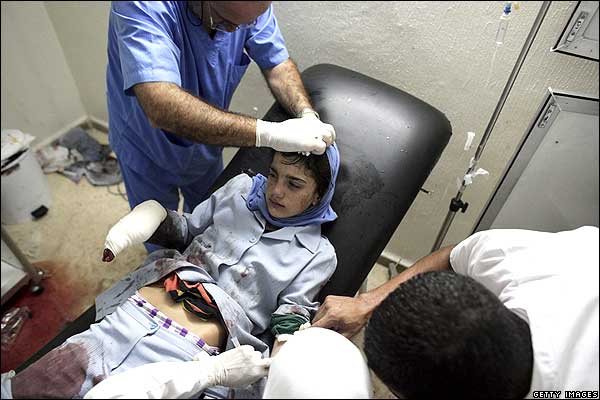
Photo Credit: Getty images, retrieved from BBC News.
Something I believe I did not emphasize enough in my post about the most recent eruption of violence in the Middle East is the human toll. When discussing the subject with peers it is often hard to truelly internalize the human cost that occurs with large scale violence. In the case of the Hizbollah and Israel conflict, hundreds of innocent civilians are being killed. Countless others are having their homes destroyed, belongings taken away, and all around undergoing a reality that, frankly, I cannot identify with.
Just remember that when you are discussing policy, opinions, whatever argument you are making for whatever action...that humans are involved, and they feel just like we do.
Saturday, July 22, 2006
Lebanon-Powder Keg?
I certainly hope not.
Granted that Israel and its citizens have been subject to countless acts of terrorism and gratuitous violence, just like our fellow human Iraqis today (or the countless others before---Tutsis-Armenians-Jews-AfricanAmericans-political dissenters-heretics-immigrants-those that are different & so forth---)the conflict that clearly has skyrocketed to the forefront of international attention between Israel and Hizbollah militants in Lebanon is tragic, troubling, and personally highlights the absurdity of the collective state of spirituality /or religious interpretation, and the human condition that accompanies our lives in the world today.
Where are we, as humans, headed? Will it take a hostile alien invasion for us to realize that, although different in millions of precious, beautiful, and at times touchy ways-we are all capable of contributing towards the development and enrichment of the human experience-past through learning, present through compassion, and future through knowledge.
Perhaps I'm being ideal. We see, hear, smell, and do nothing or maybe even contribute to the negative more often than most would care to admit.
Hip-Hop. Personally I think this is a conflict that Hip-Hop has only recently begun to organize itself, through members of the community, into some sort of tangible entity that can influence situations like the aforementioned in more than just a marginal or secondary manner. This most recent rise in violence in the Middle East is the most current event in a conflict that through thick-and-thin, breaks and mistakes, has lasted thousands of years. Hip-Hop culture-a term I will use to describe the global community that has developed around the Afro-diasporic youth culture born in the Bronx, NY-is at most forty years old.
Perhaps we could make a difference in the global effort to create peace by stopping some of the killings in our own communities right here, wherever here is for you. You hear of torture in CIA prisons, Iranian jails, Russian goulags...but recently a story has surfaced about torture amongst American university students.
There are calls for international solidarity condemning the violence, primarily in the Middle East. Shame on the G8 countries' leadership for their pathetic statements concerning the situation. If you are indeed the leaders of the so-called civilized world, and the most powerful nations, use some of that clout to broker peace.
Don't get me wrong. I love my country. The United States of America is a big part of who am I today. I've utilized the freedoms I've been given. I applaud and appreciate but deplore and detest some of the actions of our government and the citizens who make it up.
I think the biggest question for Hip-Hop, once it becomes politically organized and capable of popular, coherent policy making is: Change the system from within? Or pressure the system from without?
Back to the immediate issue...
I wish we could say that this needs to stop right now...
I wish we could say that this is unexpected...
But that is unrealistic and ignorant, respectively.
I wish we could objectively and definitively articulate every political and military entities' opinions, goals/motives, genuine allegiances, etc. For example, does George W. Bush really think that Syria is directly responsible and in control of Hizbollah's actions? Did Iranian leaders carefully time, organize, and facilitate the kidnappings? Don't most of the people in the world just want to live peacefully, enjoy fun times with loved ones, make an honest living, and share their knowledge, talents, and spirit with others? What would China do if Samuel Huntington's predictions about a clash of civilizations started first between the West and Islam? Has America actually lost control-the kind associated with a hegemon-of the situation? Do the religious clerics that preach violence really believe that this is what God wants...to kill? Would Mahmoud Ahmadinejad not enjoy rollin' with me in a Benz going 100 down I-280 in CA knockin' (loudly playing) some sublime, invigorating music-such as Santana? And the list goes on, and on, and on. The main point is I wonder who (all the major, highly influential parties involved) is pulling the strings, what strings are being pulled, and why!
I'm not sure if anyone knows how to solve the problems of the world. I guess all we can do, that is those of us who want harmony, well-being, and happiness for our fellow humans is to try and spread hope, wealth, comfort, and health to the humans of the world. I stress, it's ludicrous to expect to make up for all the injustices that humans are guilty of over the course of history. However, it is simple to conduct yourself in a way that is honest, generous, appreciative, respectful, and most of all above all the everyday nonsense that doesn't really matter and adds to the negative, hopeless, and hateful.
My final paragraph. I'm grateful for my life, my friends, and my family. My thoughts are with the families of victims of violence in the Middle East and I pray for a solid, agreeable, and lasting peace in the Middle East.
Granted that Israel and its citizens have been subject to countless acts of terrorism and gratuitous violence, just like our fellow human Iraqis today (or the countless others before---Tutsis-Armenians-Jews-AfricanAmericans-political dissenters-heretics-immigrants-those that are different & so forth---)the conflict that clearly has skyrocketed to the forefront of international attention between Israel and Hizbollah militants in Lebanon is tragic, troubling, and personally highlights the absurdity of the collective state of spirituality /or religious interpretation, and the human condition that accompanies our lives in the world today.
Where are we, as humans, headed? Will it take a hostile alien invasion for us to realize that, although different in millions of precious, beautiful, and at times touchy ways-we are all capable of contributing towards the development and enrichment of the human experience-past through learning, present through compassion, and future through knowledge.
Perhaps I'm being ideal. We see, hear, smell, and do nothing or maybe even contribute to the negative more often than most would care to admit.
Hip-Hop. Personally I think this is a conflict that Hip-Hop has only recently begun to organize itself, through members of the community, into some sort of tangible entity that can influence situations like the aforementioned in more than just a marginal or secondary manner. This most recent rise in violence in the Middle East is the most current event in a conflict that through thick-and-thin, breaks and mistakes, has lasted thousands of years. Hip-Hop culture-a term I will use to describe the global community that has developed around the Afro-diasporic youth culture born in the Bronx, NY-is at most forty years old.
Perhaps we could make a difference in the global effort to create peace by stopping some of the killings in our own communities right here, wherever here is for you. You hear of torture in CIA prisons, Iranian jails, Russian goulags...but recently a story has surfaced about torture amongst American university students.
There are calls for international solidarity condemning the violence, primarily in the Middle East. Shame on the G8 countries' leadership for their pathetic statements concerning the situation. If you are indeed the leaders of the so-called civilized world, and the most powerful nations, use some of that clout to broker peace.
Don't get me wrong. I love my country. The United States of America is a big part of who am I today. I've utilized the freedoms I've been given. I applaud and appreciate but deplore and detest some of the actions of our government and the citizens who make it up.
I think the biggest question for Hip-Hop, once it becomes politically organized and capable of popular, coherent policy making is: Change the system from within? Or pressure the system from without?
Back to the immediate issue...
I wish we could say that this needs to stop right now...
I wish we could say that this is unexpected...
But that is unrealistic and ignorant, respectively.
I wish we could objectively and definitively articulate every political and military entities' opinions, goals/motives, genuine allegiances, etc. For example, does George W. Bush really think that Syria is directly responsible and in control of Hizbollah's actions? Did Iranian leaders carefully time, organize, and facilitate the kidnappings? Don't most of the people in the world just want to live peacefully, enjoy fun times with loved ones, make an honest living, and share their knowledge, talents, and spirit with others? What would China do if Samuel Huntington's predictions about a clash of civilizations started first between the West and Islam? Has America actually lost control-the kind associated with a hegemon-of the situation? Do the religious clerics that preach violence really believe that this is what God wants...to kill? Would Mahmoud Ahmadinejad not enjoy rollin' with me in a Benz going 100 down I-280 in CA knockin' (loudly playing) some sublime, invigorating music-such as Santana? And the list goes on, and on, and on. The main point is I wonder who (all the major, highly influential parties involved) is pulling the strings, what strings are being pulled, and why!
I'm not sure if anyone knows how to solve the problems of the world. I guess all we can do, that is those of us who want harmony, well-being, and happiness for our fellow humans is to try and spread hope, wealth, comfort, and health to the humans of the world. I stress, it's ludicrous to expect to make up for all the injustices that humans are guilty of over the course of history. However, it is simple to conduct yourself in a way that is honest, generous, appreciative, respectful, and most of all above all the everyday nonsense that doesn't really matter and adds to the negative, hopeless, and hateful.
My final paragraph. I'm grateful for my life, my friends, and my family. My thoughts are with the families of victims of violence in the Middle East and I pray for a solid, agreeable, and lasting peace in the Middle East.
Wednesday, July 19, 2006
Picking up where my book left off.
The last section of my book deals with the phenomenon of snitching in Hip-Hop culture. BET is now going to do a show addressing this issue, we'll see if the cover the bases I talked about in my book, and hopefully the'll cover some of the ones I missed. Thank you Dr. Joe Twist for the heads up.
***
"Season of the Snitch" Debates Civic Duty vs Code of the Streets
A Special Report on BET's "The Chop Up" This Coming Sunday
The ingrained -- and arguably misguided -- refusal of many members of
the hiphop generation to cooperate with law enforcement officials in
the investigation of crimes committed in the black community is the
subject of a vigorous report on this week's edition of "The Chop Up."
Entitled "Season of the Snitch," the feature is part of the show airing
this coming Sunday, July 23, at 11:30 e.s.t
Produced by veteran hiphop journalist Carlito Rodriguez, "Season of the
Witch" takes off from a number of recent cases involving such
high-profile stars as Lil Kim, Busta Rhymes, and Cam'ron, all of whom
refused to cooperate with investigations into violent crimes to which
they were witnesses. This same "no snitching" policy has helped to
ensure that the murders of Tupac Shakur, Biggie Smalls, and Jam Master
Jay remain unsolved. As the report puts is: "The Golden Rule of the
criminal class has become our generation's all-out prohibition against
talking to the police."
"Season of the Snitch" delves into the deep roots of the black
community's distrust of the police. It also notes the hiphop
generation's adoption of the Mafia's code of omerta -- and the linked
belief that snitching is a "career killer" for rappers. "Just get on
the {witness} stand and the hood will label you a snitch -- plain and
simple," according to Biggie's old associate Lil Cease.
Some hiphoppers find this attitude absurd. "Stop snitching on who?"
wonders the rapper Saigon. "If we wasn't killin' each other, we
wouldn't have anything to snitch about."
A newsmagazine for the hiphop generation, "The Chop Up" has been
described as "a unique mix of '60 Minutes' and 'The Daily Show.'"
Since its debut on April 30, the show's in-depth stories have ranged
from an expose on diamond mining in Liberia to a re-investigation of
the murder of Biggie Smalls to a report on the devastating introduction
of the "white drug" called crystal meth into the black community, both
gay and straight. Hosted by Jeff Johnson and Jina Johnson, "The Chop
Up" has been holding down its spot on Sunday mornings since its debut
on BET on April 30.
For more information, or interviews with Nina Henderson Moore (BET's
EVP of News & Public Affairs), Selwyn Hinds (creator of "The Chop Up")
or producer Carlito Rodriguez, please call Tresa Sanders, 845 623 2325,
or Bill Adler at 212 645 0061.
***
"Season of the Snitch" Debates Civic Duty vs Code of the Streets
A Special Report on BET's "The Chop Up" This Coming Sunday
The ingrained -- and arguably misguided -- refusal of many members of
the hiphop generation to cooperate with law enforcement officials in
the investigation of crimes committed in the black community is the
subject of a vigorous report on this week's edition of "The Chop Up."
Entitled "Season of the Snitch," the feature is part of the show airing
this coming Sunday, July 23, at 11:30 e.s.t
Produced by veteran hiphop journalist Carlito Rodriguez, "Season of the
Witch" takes off from a number of recent cases involving such
high-profile stars as Lil Kim, Busta Rhymes, and Cam'ron, all of whom
refused to cooperate with investigations into violent crimes to which
they were witnesses. This same "no snitching" policy has helped to
ensure that the murders of Tupac Shakur, Biggie Smalls, and Jam Master
Jay remain unsolved. As the report puts is: "The Golden Rule of the
criminal class has become our generation's all-out prohibition against
talking to the police."
"Season of the Snitch" delves into the deep roots of the black
community's distrust of the police. It also notes the hiphop
generation's adoption of the Mafia's code of omerta -- and the linked
belief that snitching is a "career killer" for rappers. "Just get on
the {witness} stand and the hood will label you a snitch -- plain and
simple," according to Biggie's old associate Lil Cease.
Some hiphoppers find this attitude absurd. "Stop snitching on who?"
wonders the rapper Saigon. "If we wasn't killin' each other, we
wouldn't have anything to snitch about."
A newsmagazine for the hiphop generation, "The Chop Up" has been
described as "a unique mix of '60 Minutes' and 'The Daily Show.'"
Since its debut on April 30, the show's in-depth stories have ranged
from an expose on diamond mining in Liberia to a re-investigation of
the murder of Biggie Smalls to a report on the devastating introduction
of the "white drug" called crystal meth into the black community, both
gay and straight. Hosted by Jeff Johnson and Jina Johnson, "The Chop
Up" has been holding down its spot on Sunday mornings since its debut
on BET on April 30.
For more information, or interviews with Nina Henderson Moore (BET's
EVP of News & Public Affairs), Selwyn Hinds (creator of "The Chop Up")
or producer Carlito Rodriguez, please call Tresa Sanders, 845 623 2325,
or Bill Adler at 212 645 0061.
Ramble on.
I hope everyone is doing okay, and given the increased chaos in the Middle East that began last week and shows no sign of slowing down, appreciating the comforts that can be taken for granted in our everyday lives. Indeed, I have found myself contemplating many hypothetical situations, for example WW3, and ultimately conclude that the only thing I can pragmatically control is the aura or vibe surrounding myself, i.e., be compassionate, grateful, and carry on with life.
The book has been out for about a month now and I’m happy how things are shaping up. I’ve gotten lots of positive feedback, and yes people are pointing out the typos. That’s good, many people edited the book, but as the readers are finding out it is harder to remove all the typos in a book that one might expect. I hope to remove all the typos in the second edition of the book, should one ever arrive.
One person recently told me that my blog, aka this site, isn’t really a blog because I don’t post too much of my own opinions, etc. That’s true, and I don’t plan on increasing the posting volume of my own personal entries because my life is very busy. This site is mainly a resource for members of the Hip-Hop community to read interesting stories, find new Hip-Hop websites to browse, and of course BUY THE BOOK!!!!!
So, it’s been a while since the whole Adisa Banjoko KRS-One incident at Stanford went down. As you know the right-honorable Afrika Bambaataa has brokered peace between the two parties. That’s good because we don’t need two respected members of the community setting a bad example for the many youth that make up our culture. People come from all over the spectrum when talking about the altercation between the two men. Some are extremely supportive of one of the two, some think they’re both idiots, and some point out that one handled the situation better than the other.
I want to note one person’s response to this and give you my final words on the situation. Shane Walker, who I assume is a student at Stanford, blogged about the incident and as expected from someone who knows nothing about Adisa Banjoko was slightly biased in his coverage. And I quote…
“So basically, this symposium almost broke out into a serious throw down between a hip hop legend, and a hip hop something-or-other (I think he calls himself a scholar)… Basically, KRS One and The Bishop (a bit pretentious considering he doesn't actually perform in any capacity) have had a long feud about the definition of Hip Hop.”
The thing that struck me about this is the line about being pretentious since he doesn’t perform in any capacity. Clearly he was not familiar with Adisa’s past. Regardless, that whole situation is simply saddening.
My personal opinion is that there are things surrounding this situation that I am not aware of. Because of KRS-One’s anger during the event, he may have said some things that he did not mean (RE his comments about Hip-Hop and college and wanting to “beat Adisa…”). Similar to Zidane’s head-butt in the World Cup, it exposes to all the fans of KRS-One that this man is indeed a human and capable of mistakes in moments of intensity or extreme passion. ECCE HOMO.
I think it is moments like the one previously discussed that can cause people to become disenchanted with Hip-Hop. Is the Hip-Hop community going to foster a healthy, kind environment for people to compete, have fun, push themselves artistically and mentally, and pursue knowledge and peace? Or is it going to be a place of anger and hostility where many are not welcome, violence is encouraged through media and example, and any action is justifiable so long as it was in pursuit of material/monetary well-being or in defense of pride?
I’m not going anywhere with this other than to say that the world is, obviously, a crazy place. Hip-Hop can bring people together, and we should always utilize the power of Hip-Hop for peace. This weekend at the 2nd National Hip-Hop Political Convention many issues will undoubtedly be passionately debated. I will not be in attendance since I am working in CA, but I admire all those who do attend. Perhaps some major strides will be achieved in the quest to give the Hip-Hop community a stronger, more unified and effective political voice. That is a major step in the right direction. It is with this in mind, that Hip-Hop has great potential but a long way to go in forming political power beyond the positive externalities achieved through the already existing aesthetic aspects of the culture, that I remind us that before Hip-Hop can create world peace, it needs to be able to speak with a cohesive, coherent voice.
I am a humble, and relatively insignificant part of this journey I believe. I don’t consider myself Hip-Hop. I do enjoy and appreciate the culture, and therefore hope for the best…
Now if we can only agree on what the best is.
The book has been out for about a month now and I’m happy how things are shaping up. I’ve gotten lots of positive feedback, and yes people are pointing out the typos. That’s good, many people edited the book, but as the readers are finding out it is harder to remove all the typos in a book that one might expect. I hope to remove all the typos in the second edition of the book, should one ever arrive.
One person recently told me that my blog, aka this site, isn’t really a blog because I don’t post too much of my own opinions, etc. That’s true, and I don’t plan on increasing the posting volume of my own personal entries because my life is very busy. This site is mainly a resource for members of the Hip-Hop community to read interesting stories, find new Hip-Hop websites to browse, and of course BUY THE BOOK!!!!!
So, it’s been a while since the whole Adisa Banjoko KRS-One incident at Stanford went down. As you know the right-honorable Afrika Bambaataa has brokered peace between the two parties. That’s good because we don’t need two respected members of the community setting a bad example for the many youth that make up our culture. People come from all over the spectrum when talking about the altercation between the two men. Some are extremely supportive of one of the two, some think they’re both idiots, and some point out that one handled the situation better than the other.
I want to note one person’s response to this and give you my final words on the situation. Shane Walker, who I assume is a student at Stanford, blogged about the incident and as expected from someone who knows nothing about Adisa Banjoko was slightly biased in his coverage. And I quote…
“So basically, this symposium almost broke out into a serious throw down between a hip hop legend, and a hip hop something-or-other (I think he calls himself a scholar)… Basically, KRS One and The Bishop (a bit pretentious considering he doesn't actually perform in any capacity) have had a long feud about the definition of Hip Hop.”
The thing that struck me about this is the line about being pretentious since he doesn’t perform in any capacity. Clearly he was not familiar with Adisa’s past. Regardless, that whole situation is simply saddening.
My personal opinion is that there are things surrounding this situation that I am not aware of. Because of KRS-One’s anger during the event, he may have said some things that he did not mean (RE his comments about Hip-Hop and college and wanting to “beat Adisa…”). Similar to Zidane’s head-butt in the World Cup, it exposes to all the fans of KRS-One that this man is indeed a human and capable of mistakes in moments of intensity or extreme passion. ECCE HOMO.
I think it is moments like the one previously discussed that can cause people to become disenchanted with Hip-Hop. Is the Hip-Hop community going to foster a healthy, kind environment for people to compete, have fun, push themselves artistically and mentally, and pursue knowledge and peace? Or is it going to be a place of anger and hostility where many are not welcome, violence is encouraged through media and example, and any action is justifiable so long as it was in pursuit of material/monetary well-being or in defense of pride?
I’m not going anywhere with this other than to say that the world is, obviously, a crazy place. Hip-Hop can bring people together, and we should always utilize the power of Hip-Hop for peace. This weekend at the 2nd National Hip-Hop Political Convention many issues will undoubtedly be passionately debated. I will not be in attendance since I am working in CA, but I admire all those who do attend. Perhaps some major strides will be achieved in the quest to give the Hip-Hop community a stronger, more unified and effective political voice. That is a major step in the right direction. It is with this in mind, that Hip-Hop has great potential but a long way to go in forming political power beyond the positive externalities achieved through the already existing aesthetic aspects of the culture, that I remind us that before Hip-Hop can create world peace, it needs to be able to speak with a cohesive, coherent voice.
I am a humble, and relatively insignificant part of this journey I believe. I don’t consider myself Hip-Hop. I do enjoy and appreciate the culture, and therefore hope for the best…
Now if we can only agree on what the best is.
National Hip-Hop Political Convention
I got this from Davey D.
******
Bigger than Hip-Hop: The Nat'l Hip Hop Political Convention Bigger than Hip-Hop
By Jeff Chang
July 07, 2006
www.pbs.org/pov/borders/2...00326.html
An Interview with TJ Crawford of the National Hip-Hop Political Convention
Also check out the official website...
www.2006hiphopconvention.org/
Later this month, from July 21st through the 23rd, the 2nd National Hip-Hop Political Convention gets underway in Chicago. The first convention, held in Newark two years ago, created much excitement amongst hip-hop activists. Hip-hop activists hoped to mobilize their generation's equivalent to the 1972 National Black Political Assembly in Gary, Indiana, an historic event of the Black Power generation. Thousands from across the country sent their Local Organizing Committees to set the first ever National Hip-Hop Political Agenda.
Here we speak with T.J. Crawford, the Chair of the Host Committee for the 2006 Convention. Known as Theoretic the MC, Crawford is recognized as a one of the 10 most influential people in hip-hop and politics. He was an organizer for Atlanta's renowned Youth Task Force, and founded the Chicago Hip-Hop Political Action Committee. As he prepares for the Convention in Chicago, we spoke to him about the impact of the 2004 Convention on the politics of the hip-hop generation.
Jeff Chang: What made the 2004 National Hip-Hop Political Convention so historic?
T.J. Crawford: I think the 2004 NHHPC was a historic event because, for our generation, something like this had never been done before. Hundreds of people from differing cities and states came together to develop a national agenda that actually came from the bottom up versus the normal top down approach. Nobody sat up and legislated what would be the main areas of focus for the entire country, but instead you had local communities identifying what they found common amongst each other, and then we developed the national agenda using the locals as a base. That's powerful.
And beyond that, you had some of the best organizers, activists and academicians in the country, along with some of America's most committed and community involved young adults, mostly of color, sitting together in one place, smashing through issues, with the specific intent of getting something accomplished...of building an apparatus and preparing themselves to exercise power. The energy that you get from something like that is indescribable, and it has spawned national relationships and organizational partnerships that are continuing to this day. The web of hip-hop activism, a combination of the culture, grassroots and electoral politics, continues to grow and gain strength. It has already caught hold with so many people. I look forward to growing with it.
Jeff Chang: In the wake of the convention, how have you seen organizations like your own and similar ones across the country used hip-hop to change their communities?
T.J. Crawford: From a cultural perspective, there are countless names and organizations that we could run down that are literally saving young people's lives through after school and Saturday programs that feature hip-hop in the dance, video, film, music production, spoken word, graff and mural projects. There are thousands of people out there that are meeting kids right where they're at, giving them a harsh look at reality, while also introducing them to the power that they hold within themselves.
The expressive part of hip-hop culture, without the violence, and with knowledge of self, is the most empowering thing moving today. Not because of anything unique to hip-hop, but because hip-hop, in my eyes, is a combination and continuation of all indigenous art forms and learning pathologies that have come before. So it's like the best of all worlds finding a home in the five elements.
Now, politically speaking, I think we're still working to find our groove. I mean, you've got projects such as Biko Baker and the Campaign Against Violence in Milwaukee, and Khari Mosley and the League of Young Voters work out in Pittsburgh. You've got Troy Nkrumah and cats in Las Vegas moving against the anti-hip-hop ordinance and you've got more organizations than you can name that have shown tremendous support for the victims of Katrina, but as a generation, I think we're just getting to the point of being serious about institution building, to the point that we can change the institutions that run this country.
People like Alisha Thomas Morgan in Georgia and Ras Baraka are working to make waves on the elected side, but we're still working to get the hip-hop community to see itself as an electoral base that can move things, right here, right now. And that will only come with institution building, which is one of the things that this year's convention hopes to support.
Jeff Chang: The first Convention began with a heated, raucous day-long panel on intergenerational relations in which elders and hip-hop generationers tried to come to a middle ground about issues that divided them. Do you still see the generation gap as a pressing issue in 2006?
T.J. Crawford: I think the gap is closing, really. And I don't think it was as large as we sometimes want to say it is. Community leaders of the past don't want to give you any props until you do something, and young cats find it hard to make it happen unless some of the older folks get out the way. Well, as the Creator would have it, our communities are getting bombarded from all sides and the traditional leadership is slowly yet steadily passing away. People of conscience are recognizing this shift and are scrambling to prepare and support this current generation of leadership with the means, know how and opportunity to take over the mantle of leadership. And a lot of us are grasping the reins. I mean, don't get me wrong, there is still a lot of egotism and in fighting that takes place, especially amongst those that get checks from corporations for being THE community advocate, but I see more and more examples of the elders reaching out to work with young people, especially in my situation, and some of the people I know. So I'm encouraged by that.
Jeff Chang: What will be the two or three main issues you expect organizers and activists will be discussing at this Convention?
T.J. Crawford: It's hard to wittle that down to just three things, because there are so many issues that are relevant and intertwined. How can you talk about the effects of Hurricane Katrina without talking about our present economic situation or the lack of committed public officials and corporate leaders that not only care, but have the power, to make sure that all of this country's citizens have the basic necessities to live a healthy and sustainable life? How can you talk about basic necessities without talking about education, especially early education, as a necessary premise for mental and physical development? How can you talk about improving education without moving to the criminal justice system and the whole sale warehousing of Black and Brown youth, who seem increasingly SET UP for failure.
I don't know man, cutting it to three, that's hard. But if I had to choose, I'd probably say that it's going to be the media, institutional development, and crimes against humanity, including the aftermath of Katrina, the war, and the inept education and rehabilitative systems. You liked the way I got past the number three, huh?!
Jeff Chang: The hip-hop generation now seems to span 14 year-old youths to 40+ year-old adults. What do you see as the long-term effects of the Convention on this generation?
T.J. Crawford: I see the 2006 convention as a training ground where organizers, both younger and older, will pick up and enhance their skill set so that they can return home with an even greater ability to create the change that the want to see. I see the updating of the National Hip-Hop Political Agenda, and the promotion of it even after the convention, as a way to guide the generation from both a political and community standpoint, helping to shed light on the issues and keep us focused as we work to address them. And finally, I see the true merging of hip-hop culture and civic engagement as something that will take root and spawn some sustainable institutions that will still be around 20 to 30 years from now.
I think the convention will continue to challenge conventional wisdom (pun not intended!) and dare people to put up or shut up. Stop talking or start walking. It's your choice. We are all responsible and will be held accountable for the world that we live in, starting first with ourselves, our families and then onto the communities in which we live. I see it continuing to blur the line between grassroots activism and electoral participation. And I see it definitely helping to define hip-hop Culture for ourselves instead of regurgitating what others would have us believe it is. Our political and economic might, held together by cultural commonality and strength, will continue to provide us with the means to tell our own stories and to write our own checks. Some of that stuff we're doing already. It's about expanding it so there's enough benefit and opportunity for all of us.
===================================
The 2006 National Hip Hop Political Convention
The 2006 National Hip Hop Political Convention, scheduled to be held in Chicago, IL from July 20– 23, 2006 at Northeastern Illinois’ Jacob Carruthers Center for Inner City Studies, will build upon the past success of the 2004 convention in Newark, New Jersey to become one of the largest youth led, civic education projects in the history of the United States! By training, educating and engaging youth and young adults from across the country about the ins and outs of commerce, grassroots activism, issue education, personal and collective responsibility, community development, governmental processes and civic participation, the 2006 National Hip Hop Political Convention will help shape our country’s outlook and activities for years to come!
Money. Power. Respect. Convention Goals
The term Money, Power, Respect is universally understood among members of the Hip Hop Generation, with many of us engaged in a never ending quest to attain all three. For our purposes, it is a term derived from an economic (Money), political (Power) and social (Respect) construct that acts as a starting point from which we can examine ourselves as both individuals and a society. It speaks to how we provide for ourselves, how we interact with one another, how we affect our own reality, and identifies that which we, as a community and as a generation, hold in high esteem. The 2006 National Hip Hop Political Convention will celebrate, encourage and energize the national work of the Hip Hop community by:
1) Strengthening a state based, national coalition of hip hop organizations and leadership, via our National Assembly and the updating of the National Hip Hop Political Agenda
2) Providing training and organizational support for 1,200 Hip Hop leaders from across the country (Convention Delegates)
3) Hosting 10,000 youth and young adults interested in joining the community empowerment efforts of the Hip Hop Generation, via our concerts, workshops, town meetings and expo areas
4) Raising $150,000 for NHHPC staff and office space
5) Generate tourism dollars for the city of Chicago that is, both directly and indirectly, associated with the convention during its duration.
6) Registering over 50,000 young adults to vote before, during and after the convention.
******
Bigger than Hip-Hop: The Nat'l Hip Hop Political Convention Bigger than Hip-Hop
By Jeff Chang
July 07, 2006
www.pbs.org/pov/borders/2...00326.html
An Interview with TJ Crawford of the National Hip-Hop Political Convention
Also check out the official website...
www.2006hiphopconvention.org/
Later this month, from July 21st through the 23rd, the 2nd National Hip-Hop Political Convention gets underway in Chicago. The first convention, held in Newark two years ago, created much excitement amongst hip-hop activists. Hip-hop activists hoped to mobilize their generation's equivalent to the 1972 National Black Political Assembly in Gary, Indiana, an historic event of the Black Power generation. Thousands from across the country sent their Local Organizing Committees to set the first ever National Hip-Hop Political Agenda.
Here we speak with T.J. Crawford, the Chair of the Host Committee for the 2006 Convention. Known as Theoretic the MC, Crawford is recognized as a one of the 10 most influential people in hip-hop and politics. He was an organizer for Atlanta's renowned Youth Task Force, and founded the Chicago Hip-Hop Political Action Committee. As he prepares for the Convention in Chicago, we spoke to him about the impact of the 2004 Convention on the politics of the hip-hop generation.
Jeff Chang: What made the 2004 National Hip-Hop Political Convention so historic?
T.J. Crawford: I think the 2004 NHHPC was a historic event because, for our generation, something like this had never been done before. Hundreds of people from differing cities and states came together to develop a national agenda that actually came from the bottom up versus the normal top down approach. Nobody sat up and legislated what would be the main areas of focus for the entire country, but instead you had local communities identifying what they found common amongst each other, and then we developed the national agenda using the locals as a base. That's powerful.
And beyond that, you had some of the best organizers, activists and academicians in the country, along with some of America's most committed and community involved young adults, mostly of color, sitting together in one place, smashing through issues, with the specific intent of getting something accomplished...of building an apparatus and preparing themselves to exercise power. The energy that you get from something like that is indescribable, and it has spawned national relationships and organizational partnerships that are continuing to this day. The web of hip-hop activism, a combination of the culture, grassroots and electoral politics, continues to grow and gain strength. It has already caught hold with so many people. I look forward to growing with it.
Jeff Chang: In the wake of the convention, how have you seen organizations like your own and similar ones across the country used hip-hop to change their communities?
T.J. Crawford: From a cultural perspective, there are countless names and organizations that we could run down that are literally saving young people's lives through after school and Saturday programs that feature hip-hop in the dance, video, film, music production, spoken word, graff and mural projects. There are thousands of people out there that are meeting kids right where they're at, giving them a harsh look at reality, while also introducing them to the power that they hold within themselves.
The expressive part of hip-hop culture, without the violence, and with knowledge of self, is the most empowering thing moving today. Not because of anything unique to hip-hop, but because hip-hop, in my eyes, is a combination and continuation of all indigenous art forms and learning pathologies that have come before. So it's like the best of all worlds finding a home in the five elements.
Now, politically speaking, I think we're still working to find our groove. I mean, you've got projects such as Biko Baker and the Campaign Against Violence in Milwaukee, and Khari Mosley and the League of Young Voters work out in Pittsburgh. You've got Troy Nkrumah and cats in Las Vegas moving against the anti-hip-hop ordinance and you've got more organizations than you can name that have shown tremendous support for the victims of Katrina, but as a generation, I think we're just getting to the point of being serious about institution building, to the point that we can change the institutions that run this country.
People like Alisha Thomas Morgan in Georgia and Ras Baraka are working to make waves on the elected side, but we're still working to get the hip-hop community to see itself as an electoral base that can move things, right here, right now. And that will only come with institution building, which is one of the things that this year's convention hopes to support.
Jeff Chang: The first Convention began with a heated, raucous day-long panel on intergenerational relations in which elders and hip-hop generationers tried to come to a middle ground about issues that divided them. Do you still see the generation gap as a pressing issue in 2006?
T.J. Crawford: I think the gap is closing, really. And I don't think it was as large as we sometimes want to say it is. Community leaders of the past don't want to give you any props until you do something, and young cats find it hard to make it happen unless some of the older folks get out the way. Well, as the Creator would have it, our communities are getting bombarded from all sides and the traditional leadership is slowly yet steadily passing away. People of conscience are recognizing this shift and are scrambling to prepare and support this current generation of leadership with the means, know how and opportunity to take over the mantle of leadership. And a lot of us are grasping the reins. I mean, don't get me wrong, there is still a lot of egotism and in fighting that takes place, especially amongst those that get checks from corporations for being THE community advocate, but I see more and more examples of the elders reaching out to work with young people, especially in my situation, and some of the people I know. So I'm encouraged by that.
Jeff Chang: What will be the two or three main issues you expect organizers and activists will be discussing at this Convention?
T.J. Crawford: It's hard to wittle that down to just three things, because there are so many issues that are relevant and intertwined. How can you talk about the effects of Hurricane Katrina without talking about our present economic situation or the lack of committed public officials and corporate leaders that not only care, but have the power, to make sure that all of this country's citizens have the basic necessities to live a healthy and sustainable life? How can you talk about basic necessities without talking about education, especially early education, as a necessary premise for mental and physical development? How can you talk about improving education without moving to the criminal justice system and the whole sale warehousing of Black and Brown youth, who seem increasingly SET UP for failure.
I don't know man, cutting it to three, that's hard. But if I had to choose, I'd probably say that it's going to be the media, institutional development, and crimes against humanity, including the aftermath of Katrina, the war, and the inept education and rehabilitative systems. You liked the way I got past the number three, huh?!
Jeff Chang: The hip-hop generation now seems to span 14 year-old youths to 40+ year-old adults. What do you see as the long-term effects of the Convention on this generation?
T.J. Crawford: I see the 2006 convention as a training ground where organizers, both younger and older, will pick up and enhance their skill set so that they can return home with an even greater ability to create the change that the want to see. I see the updating of the National Hip-Hop Political Agenda, and the promotion of it even after the convention, as a way to guide the generation from both a political and community standpoint, helping to shed light on the issues and keep us focused as we work to address them. And finally, I see the true merging of hip-hop culture and civic engagement as something that will take root and spawn some sustainable institutions that will still be around 20 to 30 years from now.
I think the convention will continue to challenge conventional wisdom (pun not intended!) and dare people to put up or shut up. Stop talking or start walking. It's your choice. We are all responsible and will be held accountable for the world that we live in, starting first with ourselves, our families and then onto the communities in which we live. I see it continuing to blur the line between grassroots activism and electoral participation. And I see it definitely helping to define hip-hop Culture for ourselves instead of regurgitating what others would have us believe it is. Our political and economic might, held together by cultural commonality and strength, will continue to provide us with the means to tell our own stories and to write our own checks. Some of that stuff we're doing already. It's about expanding it so there's enough benefit and opportunity for all of us.
===================================
The 2006 National Hip Hop Political Convention
The 2006 National Hip Hop Political Convention, scheduled to be held in Chicago, IL from July 20– 23, 2006 at Northeastern Illinois’ Jacob Carruthers Center for Inner City Studies, will build upon the past success of the 2004 convention in Newark, New Jersey to become one of the largest youth led, civic education projects in the history of the United States! By training, educating and engaging youth and young adults from across the country about the ins and outs of commerce, grassroots activism, issue education, personal and collective responsibility, community development, governmental processes and civic participation, the 2006 National Hip Hop Political Convention will help shape our country’s outlook and activities for years to come!
Money. Power. Respect. Convention Goals
The term Money, Power, Respect is universally understood among members of the Hip Hop Generation, with many of us engaged in a never ending quest to attain all three. For our purposes, it is a term derived from an economic (Money), political (Power) and social (Respect) construct that acts as a starting point from which we can examine ourselves as both individuals and a society. It speaks to how we provide for ourselves, how we interact with one another, how we affect our own reality, and identifies that which we, as a community and as a generation, hold in high esteem. The 2006 National Hip Hop Political Convention will celebrate, encourage and energize the national work of the Hip Hop community by:
1) Strengthening a state based, national coalition of hip hop organizations and leadership, via our National Assembly and the updating of the National Hip Hop Political Agenda
2) Providing training and organizational support for 1,200 Hip Hop leaders from across the country (Convention Delegates)
3) Hosting 10,000 youth and young adults interested in joining the community empowerment efforts of the Hip Hop Generation, via our concerts, workshops, town meetings and expo areas
4) Raising $150,000 for NHHPC staff and office space
5) Generate tourism dollars for the city of Chicago that is, both directly and indirectly, associated with the convention during its duration.
6) Registering over 50,000 young adults to vote before, during and after the convention.
Thursday, July 13, 2006
Bling, Bling, every time I buy a new...

From MTV PR.
***
VH1 IN SIERRA LEONE THIS WEEK WITH HIP-HOP ARTISTS PAUL WALL, RAEKWON AND TEGO CALDERON FILMING ITS NEWEST ROCK DOC, “BLING: A PLANET ROCK” (tentative title)
SANTA MONICA, CA, July 12, 2006 - VH1 is in Sierra Leone this week with hip-hop artists Paul Wall, Raekwon (of Wu Tang Clan), and reggaeton king Tego Calderon, to begin filming “Bling: A Planet Rock” (tentative title), a new documentary under VH1’s Rock Docs franchise. The film set to air on VH1 in early 2007 will take a hard-hitting look at the diamond trade in Sierra Leone, West Africa, and how “blinging” in the flashy world of commercial hip-hop played a role in the country’s civil war.
The 11-year war was largely perpetuated by genocidal rebels and primarily funded through the illegal trading of conflict or “blood” diamonds. Wall, Raekwon and Calderon will hear first-hand accounts of the atrocities suffered during this time and the role that diamonds played as they visit mining communities and meet with local musicians, government officials and children. Produced by Article 19 Films in association with VH1 and the United Nations Development Program, “Bling: A Planet Rock,” will capture hip-hop’s reaction to the human violations, bring global awareness to this issue, and educate Americans about how they can play a role in eradicating the smuggling of blood diamonds.
Contact: Scott Acord/VH1
310-752-8075
****

Saturday, July 08, 2006
A Farm Is Destroyed In South Central

Photo Credit: Javier Manzano, LATimes
Mercî Davey D.
*********
Violence Erupts Against South Central Farm Supporters
As Landowner Bulldozes Farm – Legal Observers Watch Brutality
WHAT: Less than 24 hours after Independence Day, as legal observers, local residents and farmers watched on, Ralph Horowitz began bulldozing the South Central Farm under the guise of “pruning.” Hired security forces punched and pinned down supporters who tried to prevent the bulldozer from uprooting the hundreds of fruit trees while police officers watched on. Ten supporters were arrested.
Attorney and legal observer Colleen Flynn attempted to de-escalate the violence and reduce the use of force by security guards, “I was inside the property yesterday and everyone who participated in the action was committed to non-violence,” she says. “They only gave passive resistance and the security and the police officers were the ones who were violent. The security guards held protesters down and punched them. Any accusations that the protesters were violent are inaccurate,” she continues.
Despite these tragic developments, supporters say the farm can still be saved because Mr. Horowitz’s claim to the land may be illegal. Yesterday’s destructive and aggressive actions will have major repercussions to him and the City of Los Angeles. “Mr. Horowitz is mocking the grandmothers, mothers, and children in this impoverished community when he stated to the L.A. Times that the Farm needed ‘pruning.’ Mothers and children watched in tears, as the plants they had tended for over a decade were destroyed,” stated Tezozomoc, elected representative of the South Central Farmers.
WHERE: South Central Farm, 41st and Alameda, Los Angeles, CA
WHY: Despite the fact that South Central Farmers have continued positive outreach efforts towards developer Ralph Horowitz, his bulldozers escorted by LAPD have destroyed more than 50 percent of the 14-acre, 14-year-old urban farm. Farmers and farm supporters are assembling at the scene again today (July 6, 2006), many of them blocking bulldozers as a last effort to save the many rare plants and trees, some of which are protected under city law.
The issue of failed justice began when Ralph Horowitz bought the land from the City of Los Angeles in a closed deal for $5 Million Dollars when it was worth $13.3 million in 1994. This 2003 sale will be contested in a court case on July 12. Los Angeles residents are outraged that the city of Los Angeles squandered important city monies in this deal that could have been used for other city business. The new vision for South Central Farm includes a multi-use community center for children of surrounding neighborhoods. July 7-10 is the International Days of Solidarity for the South Central Farmers, for more information visit www.southcentralfarmers.com.
****
What Ralph Nader's website says.
And the LA TIMES.
or listen on NPR
Thursday, June 29, 2006
Gitmo=Illegal
Got this via Drudge... It's good news that the Supreme Court ruled this way because Gitmo clearly isn't adhering to international law or what I may have termed in a more innocent time, 'American moral values.' Plain and simple, Gitmo is horrible for America's global reputation and hinders the safety of Americans abroad. So, good job Supreme Court and Justice Kennedy! However, we'll wait and see what the Supreme Court has up its sleaves over the next few years *ahem* abortion.
****
Supreme Court Blocks Bush, Gitmo War Trials
Jun 29 10:32 AM US/Eastern
By GINA HOLLAND
Associated Press Writer
WASHINGTON
The Supreme Court ruled Thursday that President Bush overstepped his authority in ordering military war crimes trials for Guantanamo Bay detainees.
The ruling, a rebuke to the administration and its aggressive anti- terror policies, was written by Justice John Paul Stevens, who said the proposed trials were illegal under U.S. law and international Geneva conventions.
The case focused on Salim Ahmed Hamdan, a Yemeni who worked as a bodyguard and driver for Osama bin Laden. Hamdan, 36, has spent four years in the U.S. prison in Cuba. He faces a single count of conspiring against U.S. citizens from 1996 to November 2001.
Two years ago, the court rejected Bush's claim to have the authority to seize and detain terrorism suspects and indefinitely deny them access to courts or lawyers. In this follow-up case, the justices focused solely on the issue of trials for some of the men.
The vote was split 5-3, with moderate Justice Anthony M. Kennedy joining the court's liberal members in ruling against the Bush administration. Chief Justice John Roberts, named to the lead the court last September by Bush, was sidelined in the case because as an appeals court judge he had backed the government over Hamdan.
Thursday's ruling overturned that decision.
Bush spokesman Tony Snow said the White House would have no comment until lawyers had had a chance to review the decision. Officials at the Pentagon and Justice Department were planning to issue statements later in the day.
The administration had hinted in recent weeks that it was prepared for the court to set back its plans for trying Guantanamo detainees.
The president also has told reporters, "I'd like to close Guantanamo." But he added, "I also recognize that we're holding some people that are darn dangerous."
The court's ruling says nothing about whether the prison should be shut down, dealing only with plans to put detainees on trial.
"Trial by military commission raises separation-of-powers concerns of the highest order," Kennedy wrote in his opinion.
The prison at Guantanamo Bay, erected in the months after the Sept. 11, 2001, terror attacks on the United States, has been a flash point for international criticism. Hundreds of people suspected of ties to al-Qaida and the Taliban _ including some teenagers _ have been swept up by the U.S. military and secretly shipped there since 2002.
Three detainees committed suicide there this month, using sheets and clothing to hang themselves. The deaths brought new scrutiny and criticism of the prison, along with fresh calls for its closing.
****
I got the story here.
****
Supreme Court Blocks Bush, Gitmo War Trials
Jun 29 10:32 AM US/Eastern
By GINA HOLLAND
Associated Press Writer
WASHINGTON
The Supreme Court ruled Thursday that President Bush overstepped his authority in ordering military war crimes trials for Guantanamo Bay detainees.
The ruling, a rebuke to the administration and its aggressive anti- terror policies, was written by Justice John Paul Stevens, who said the proposed trials were illegal under U.S. law and international Geneva conventions.
The case focused on Salim Ahmed Hamdan, a Yemeni who worked as a bodyguard and driver for Osama bin Laden. Hamdan, 36, has spent four years in the U.S. prison in Cuba. He faces a single count of conspiring against U.S. citizens from 1996 to November 2001.
Two years ago, the court rejected Bush's claim to have the authority to seize and detain terrorism suspects and indefinitely deny them access to courts or lawyers. In this follow-up case, the justices focused solely on the issue of trials for some of the men.
The vote was split 5-3, with moderate Justice Anthony M. Kennedy joining the court's liberal members in ruling against the Bush administration. Chief Justice John Roberts, named to the lead the court last September by Bush, was sidelined in the case because as an appeals court judge he had backed the government over Hamdan.
Thursday's ruling overturned that decision.
Bush spokesman Tony Snow said the White House would have no comment until lawyers had had a chance to review the decision. Officials at the Pentagon and Justice Department were planning to issue statements later in the day.
The administration had hinted in recent weeks that it was prepared for the court to set back its plans for trying Guantanamo detainees.
The president also has told reporters, "I'd like to close Guantanamo." But he added, "I also recognize that we're holding some people that are darn dangerous."
The court's ruling says nothing about whether the prison should be shut down, dealing only with plans to put detainees on trial.
"Trial by military commission raises separation-of-powers concerns of the highest order," Kennedy wrote in his opinion.
The prison at Guantanamo Bay, erected in the months after the Sept. 11, 2001, terror attacks on the United States, has been a flash point for international criticism. Hundreds of people suspected of ties to al-Qaida and the Taliban _ including some teenagers _ have been swept up by the U.S. military and secretly shipped there since 2002.
Three detainees committed suicide there this month, using sheets and clothing to hang themselves. The deaths brought new scrutiny and criticism of the prison, along with fresh calls for its closing.
****
I got the story here.
Wednesday, June 28, 2006
Shakti, the Indian (American) "diva"
Peep game on Shakti. Definately an example of how Hip-Hop culture transcends a lot of what people commonly associate with it.
Shakti.
Shakti.
Mistakes do happen.
What's up y'all. There's a new book coming out by Roni Sarig called Third Coast: Outkast, Timbaland, And the Rise of Dirty South Hip Hop. Indeed, it is an accomplishment for Mr. Sarig to be releasing his third book, and I'm definately going to read it. However, I am slightly troubled by the false claim (at least on amazon) that it is the, "first in-depth look at a regional phenomenon that has exploded into a worldwide sensation: Dirty South Hip-Hop...(and) to explain the character and significance of down South rapping to fans as well as outsiders." That simply is not true. Tamara Palmer released a book called, "Country Fried Soul: Adventures in Dirty South Hip-Hop" over a year ago (March 2005). I read her book this past fall on the subway between home and college, it was real tight. Her writing was insightful, entertaining, and at times transportive. Seriously.
Of course, I'm sure Mr. Sarig's book is going to be dope too. I'm looking forward to reading it. Nonetheless, I think props should be given where props are due, and in my mind the credit for the, "first in-depth look at" Souther Hip-Hop belongs to Miss Palmer.
NOTE: You can check out cover art, reviews, etc on amazon.com should you desire.
PEACE.
Of course, I'm sure Mr. Sarig's book is going to be dope too. I'm looking forward to reading it. Nonetheless, I think props should be given where props are due, and in my mind the credit for the, "first in-depth look at" Souther Hip-Hop belongs to Miss Palmer.
NOTE: You can check out cover art, reviews, etc on amazon.com should you desire.
PEACE.
Mistakes do happen.
What's up y'all. There's a new book coming out by Roni Sarig called Third Coast: Outkast, Timbaland, And the Rise of Dirty South Hip Hop. Indeed, it is an accomplishment for Mr. Sarig to be releasing his third book, and I'm definately going to read it. However, I am slightly troubled by the false claim (at least on amazon) that it is the, "first in-depth look at a regional phenomenon that has exploded into a worldwide sensation: Dirty South Hip-Hop...(and) to explain the character and significance of down South rapping to fans as well as outsiders." That simply is not true. Tamara Palmer released a book called, Country Fried Soul: Adventures in Dirty South Hip-Hop over a year ago (March 2005). I read her book this past fall on the subway between home and college, it was real tight. Her writing was insightful, entertaining, and at times transportive. Seriously.
Of course, I'm sure Mr. Sarig's book is going to be dope too. I'm looking forward to reading it. Nonetheless, I think props should be given where props are due, and in my mind the credit for the, "first in-depth look at" Southern Hip-Hop belongs to Miss Palmer.
You can check out cover art, reviews, etc on amazon.com should you desire.
PEACE.
Of course, I'm sure Mr. Sarig's book is going to be dope too. I'm looking forward to reading it. Nonetheless, I think props should be given where props are due, and in my mind the credit for the, "first in-depth look at" Southern Hip-Hop belongs to Miss Palmer.
You can check out cover art, reviews, etc on amazon.com should you desire.
PEACE.
Thursday, June 22, 2006
Gay Hip-Hop

Photo Credit: Sugartruck Recordings.
One of the topics that came up occasionally in the interviews for my book is homosexuality and its role in Hip-Hop culture. The following is an article by Lisa Hix that I found in the SF Chronicle about a bunch of rappers who happen to be gay, don't want to dodge the issue, and apparently aren't too shaby.
***
Deep Dickollective
Oakland gay hip-hoppers started out by mocking spoken-word community, but now they're serious about excelling at craft
Lisa Hix
Thursday, June 22, 2006
With a name like Deep Dickollective, you would expect this Oakland gay hip-hop group to stimulate the nether regions. While they do perform playful rhymes about cruising the Ashby Flea Market, the emphasis here is on deep, as in stimulating the frontal lobe.
As with conscious hip-hoppers Blackalicious or Hieroglyphics, D/DC raps intellectual diatribes designed to challenge lazy thinking about race, homosexuality and identity.
D/DC's Juba Kalamka explains the name: "We didn't want to be coy. We didn't want anyone to be able to get around queerness, to get around sexuality or race. We wanted that to be foreground, we didn't want them to make any mistake when they were listening to it."
Kalamka, an early member of the influential '90s crew Rainbow Flava, is considered a godfather of the "homo-hop" movement, although he wouldn't say so. When Kalamka, Tim'm T. West and Phillip Atiba Goff, all academic types, formed Deep Dickollective in 1999, it was originally a scathing send-up of the pretense of the spoken-word community. But D/DC quickly became a serious hip-hop venture, and now features Kalamka, West, Jeree Brown, Rashad Pridgen, Leslie Taylor, Ryan Burke, Baraka Noel and Marcus Rene' Van. Kalamka credits the evolution of the Internet for bringing the homo hoppers together: All the queer boys and girls practicing rhymes alone in their rooms suddenly had a way to connect with one another, through Judge Muscat's Phat Family listserv, Mistermaker's GayHipHop.com and even MySpace. And a nationwide scene flourished, including Deadlee, Johnny Dangerous and the Bay Area's Katastrophe and JenRO, who would meet at Oakland's Peace Out festival. Alex Hinton chronicles the evolution of this tight-knit circle in his film "Pick Up the Mic," screening at the Frameline Festival at the Castro tonight.
It seems like an obvious irony to rhyme about gay pride in a genre dubbed misogynistic and homophobic, but Kalamka says that's making hip-hop and black culture the scapegoat for all our social woes. After all, most musical styles -- rock, punk, jazz, country, etc. -- have a history of hate.
"Queer hip-hop in a lot of ways is killing the bogeyman in the gay community," Kalamka says. "If you talk about gay, white upper-middle-class men ... they have had a convenient kind of bogeyman for a long time in the threatening straight hetero-normative black male. It's just kind of an easy and lazy event for classism and racism.
"But the truth be told, hip-hop doesn't create public policy. Hip-hop didn't create the Defense of Marriage Act. Hip-hop didn't create the climate in which kids like Sakia Gunn, Matthew Shepard, Brandon Teena and Gwen Araujo (are killed). That's not a new thing: The ills of society getting laid at the feet of disenfranchised people."
****
www.deepdickollective.com
Monday, June 19, 2006
iUnit *harhar*
50 Cent Negotiating With Apple For Branded Line Of Home Computers
By Nolan Strong
www.allhiphop.com/hiphopnews/?ID=5798
Rap star 50 Cent is entering the world of technology and is currently in negotiations with Apple's CEO Steve Jobs to produce a line of affordable home computers to inner-city residents.
According to a recent article in Forbes, 50 Cent, born Curtis Jackson and his high powered manager Chris Lighty of Violator management, are negotiating the branding deal with the computer /software giant.
"I'm creating a foundation that will be around for a long time, because fame can come and go or get lost in the lifestyle and the splurging," Fifty Cent explained to Forbes. "I never got into it for the music. I got into it for the business."
"He [Jobs] is setting a new standard in the music business," Lighty added. "Let's just say we get each other."
The company hopes to close the gap between sales in iPods, which have earned over $3 billion verse $2 billion from software and personal home computer sales.
Behind Jobs' leadership and the runaway success of the iPod and iTunes, Apple controls over 80% of the digital music market.
Additionally, Apple has sold over 1 billion songs over the past five years. The company started selling music videos and television shows which have sold over 15 million copies since October of 2005.
50 Cent, who is plans on releasing his untitled third album by Christmas, ranked among the Top 10 earning celebrity entertainers in Forbes' recently released Forbes Celebrity Power 100 List.
The rapper earned almost $41 million dollars, mostly from record sales and branding deals that include a clothing line, a line of sneakers, a video game and his G-Unit line of clothing, which was launched in partnership with Marc Ecko in July 2003.
50 Cent ranked #8 in the Top Ten, behind Howard Stern, Steven Spielberg, Tiger Woods, rock group U2, Oprah Winfrey, The Rolling Stones and Tom Cruise, who topped the list by earning over $67 million in 2005.
By Nolan Strong
www.allhiphop.com/hiphopnews/?ID=5798
Rap star 50 Cent is entering the world of technology and is currently in negotiations with Apple's CEO Steve Jobs to produce a line of affordable home computers to inner-city residents.
According to a recent article in Forbes, 50 Cent, born Curtis Jackson and his high powered manager Chris Lighty of Violator management, are negotiating the branding deal with the computer /software giant.
"I'm creating a foundation that will be around for a long time, because fame can come and go or get lost in the lifestyle and the splurging," Fifty Cent explained to Forbes. "I never got into it for the music. I got into it for the business."
"He [Jobs] is setting a new standard in the music business," Lighty added. "Let's just say we get each other."
The company hopes to close the gap between sales in iPods, which have earned over $3 billion verse $2 billion from software and personal home computer sales.
Behind Jobs' leadership and the runaway success of the iPod and iTunes, Apple controls over 80% of the digital music market.
Additionally, Apple has sold over 1 billion songs over the past five years. The company started selling music videos and television shows which have sold over 15 million copies since October of 2005.
50 Cent, who is plans on releasing his untitled third album by Christmas, ranked among the Top 10 earning celebrity entertainers in Forbes' recently released Forbes Celebrity Power 100 List.
The rapper earned almost $41 million dollars, mostly from record sales and branding deals that include a clothing line, a line of sneakers, a video game and his G-Unit line of clothing, which was launched in partnership with Marc Ecko in July 2003.
50 Cent ranked #8 in the Top Ten, behind Howard Stern, Steven Spielberg, Tiger Woods, rock group U2, Oprah Winfrey, The Rolling Stones and Tom Cruise, who topped the list by earning over $67 million in 2005.
Subscribe to:
Posts (Atom)